SNOW HOLIDAY
ENQUIRY
The Grasshopper – The Latest Snow Forecast

The Grasshopper – The Latest Snow Forecast

Australian Forecast – A Great End to a Great Season

Published early Friday, 3rd October 2025

Snow came in as expected during the early hours on Thursday with resorts reporting a few cents had gathered by the time they opened. Another 5cm had stacked up on Perisher’s snow stake before the snow cleared Thursday night. It’s a great wee addition to the snowpack that will see us nicely through the last four days of the season. Mt Buller, Hotham and Falls Creek will have their grand finale’s on Sunday, Thredbo and Perisher have theirs on Monday, which is a public holiday for Labour Day.

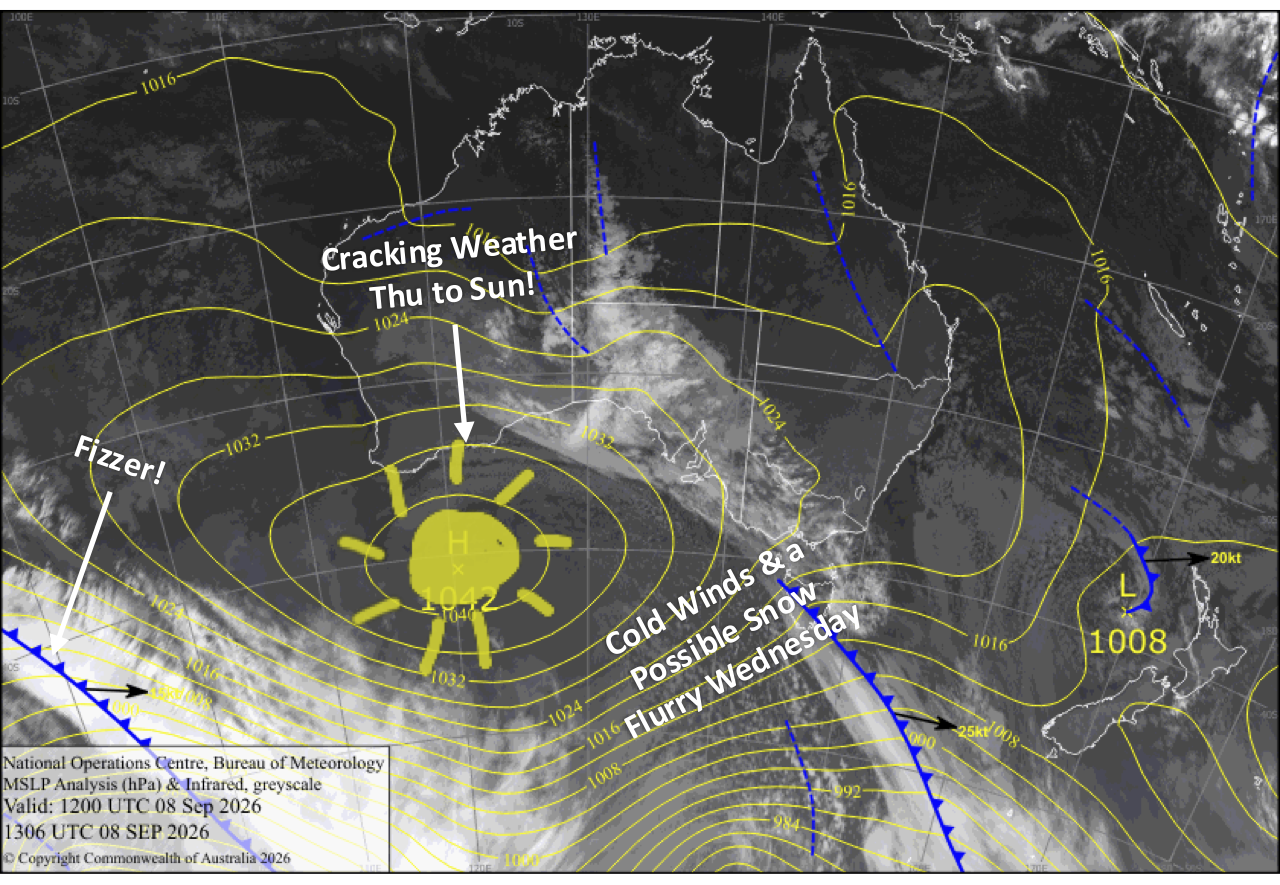
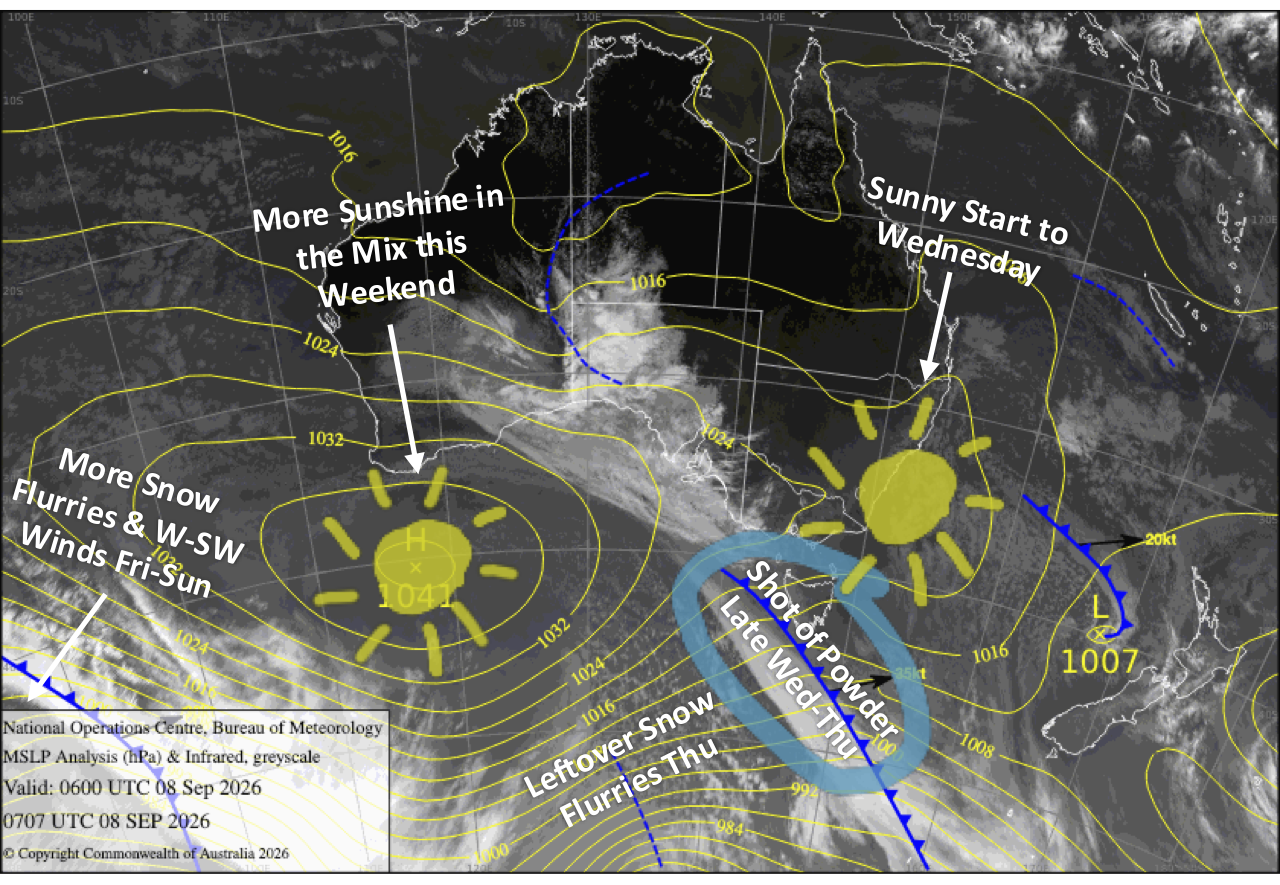
This is the final forecast of the season, which starts off with windy, mucky conditions today in Victoria, a fine start in NSW, Friday, before high pressure moves in for a warm, sunny weekend, though winds strengthen for Closing Day in Victoria on Sunday. Closing Day in NSW will have a wet, blustery start as a front passes over early Monday morning, but skies will brighten again for the season’s final turns.

Latest pressure analysis and satellite image. Source: The BOM (vandalised by the Grasshopper)

Friday 3rd October

Cloudy, clagged-in conditions with snow flurries in western Victoria, spreading elsewhere in the afternoon while turning wet and drizzly about lower and mid slopes. Strong southwesterly winds in exposed areas back off a touch.

Saturday 4th October

A ridge of high pressure brings nice, sunny skies with a little high cloud while southwest winds gradually swing northwest.

Sunday 5th October

Closing Day for Mt Buller, Hotham and Falls Creek will be dry with increasing high cloud. However, warm northwest winds strengthen, so keep an eye on lift operations.

Monday 6th October

Closing Day for Thredbo and Perisher will start with a little rain and strong northwest winds as a front passes over first thing in the morning. Behind the front, we’ll be left with partly cloudy skies with sunny spells, and lighter westerly breezes.

That’s all from me for today and the season, folks. It’s been an absolute pleasure sharing all the highs and lows with you. I’m taking off to hibernate in the back country, but I’ll be back sometime in December when the northern hemisphere season starts cranking. See you then!

Grasshopper

New Zealand Forecast – A Stormy End To The Season

Published early Friday, 3rd October 2025

Well folks, we made it. This is the last forecast of the season. Cardrona and Mt Olympus close this Sunday, leaving The Remarkables and Mt Hutt to hold the fort down south until they also close next Sunday. Whakapapa and Turoa will remain open until the 26th of October. So make the most of it while you can.

The riding continues to be exceptional in the Southern Lakes after the region scored a couple of 10-20cm powder dumps on Sunday and Tuesday night. Mt Hutt also received 5cm on Wednesday, while Mt Ruapehu had a dusting.

We’ll sneak in some nice weather for a great Friday session ahead of a Tasman Low crossing the country this weekend, bringing a mix of rain and snow. Colder southerlies arriving on the South Island late Saturday will give the Southern Lakes and Canterbury a top-up of dense snow through into Sunday.

Conditions deteriorate on Monday as strong, stormy westerlies once again arrive on Kiwi slopes, with fronts and gales expected to rattle ski fields throughout the week. However, the Southern Lakes in particular will pick up some nice shots of powder in the process.

Latest pressure analysis and satellite image. Source: The BOM (vandalised by the Grasshopper)

Friday 3rd October

A mostly clear, sunny morning up in the mountains, with low cloud filling the valleys and plains. Cloud then builds ahead of a Tasman Low, which spreads rain southwards over Mt Ruapehu in the afternoon as westerlies swing north. After dark, the rain spreads over the South Island, falling as snow to mid-levels or lower in the Southern Lakes. South Island ski fields will also have light breezes from the northerly quarter.

Saturday 4th October

A bit of a soggy day as the Tasman low continues to cross the country, bringing periods of rain to the ski fields. However, dense snow will fall to around mid-levels for the Southern Lakes, where there’ll be a cooler southeast breeze. Winds will come from the northwest for Mt Ruapehu, and northeast for Canterbury.

In the evening, snow levels fall to base levels across the South Island as a colder southerly arrives. A little snow will also fall about mid- and upper-slopes of Mt Ruapehu before drying up overnight.

Sunday 5th October

Snowfall across the South Island clears the Southern Lakes in the afternoon and Canterbury at night as the low pulls away to the east, allowing chilly southerly winds to start easing. The winds will be strong in Canterbury throughout day, which might affect lift operations. This low is likely to deliver a top-up of between 5 and 20cm from base to summit. Overall, not a bad one for Closing Day at Cardrona.

Showers of rain and upper-level snow kick up over Mt Ruapehu in the afternoon, then clear at night shortly after northwesterlies turn southerly.

Monday 6th October

Not a bad start for the South Island, but conditions will quickly deteriorate as a front approaches from the west, likely affecting lift operations. Cloud increases and northwest winds rapidly strengthen, reaching severe-gale in exposed spots, before the front spreads rain northwards during the afternoon with heavy falls on the cards. A colder westerly change at night will see the rain transition to snow.

Mt Ruapehu will see a bit of cloud and a few light showers, falling as snow about mid- to upper-slopes, while westerly winds pick up.

Tuesday 7th October

Snow showers over the Southern Lakes taper off, then clear in the afternoon with sunny skies, as brisk, chilly southwesterlies gradually swing northwest. A few more snow showers will show up at night.

Mt Hutt will score a fresh dusting of snow, thanks to a brief southwest change. Other than that, skies will be mostly clear, but winds will start strong from the northwest which may delay things.

Mt Ruapehu will cop a load of heavy rain before opening as the front passes over. Showers of snow and low-level rain will continue throughout the day with strong westerly winds.

Extended Forecast

Strong, unsettled westerlies will persist through to the end of next week, marring the season’s final days for The Remarkables and Mt Hutt, where lift operations will likely be affected. Gales will be the norm, with peaks in wind strength coming ahead of a couple of passing frontal systems due around late Thursday/Friday and next weekend. Expect a bout of rain followed by snow with both systems as they bring a dip in temperatures.

That’s all from me for today and the season, folks. It’s been an absolute pleasure sharing all the highs and lows with you. I’m taking off to hibernate in the back country, but I’ll be back sometime in December when the northern hemisphere season starts cranking. See you then!

Grasshopper

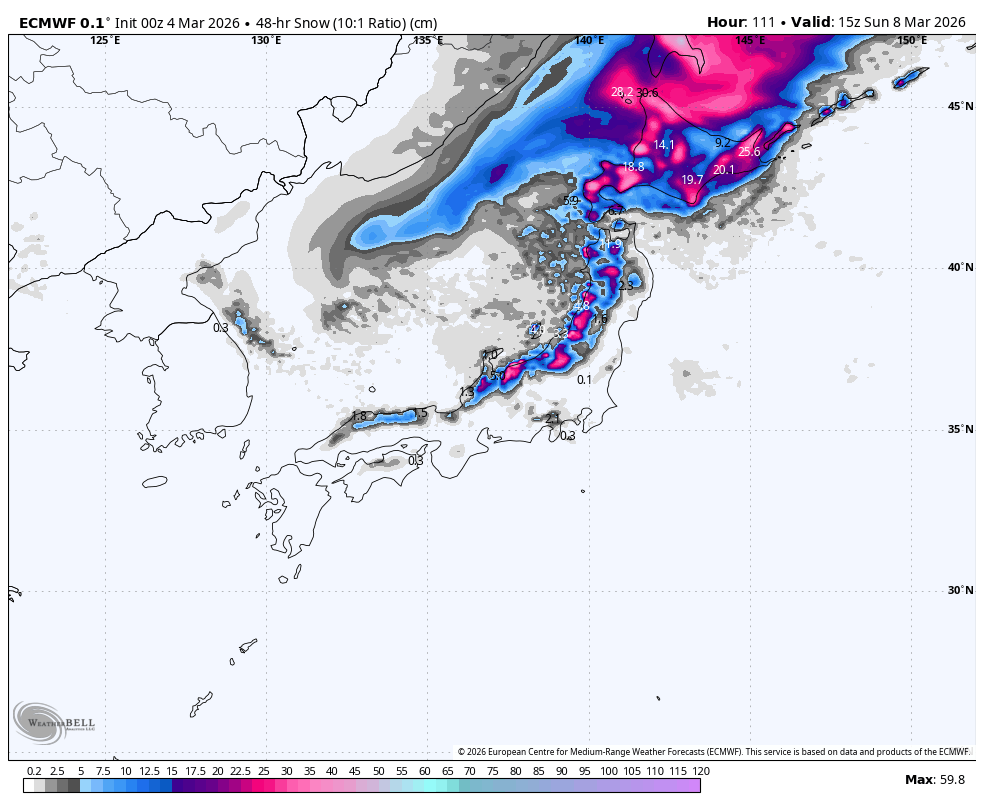
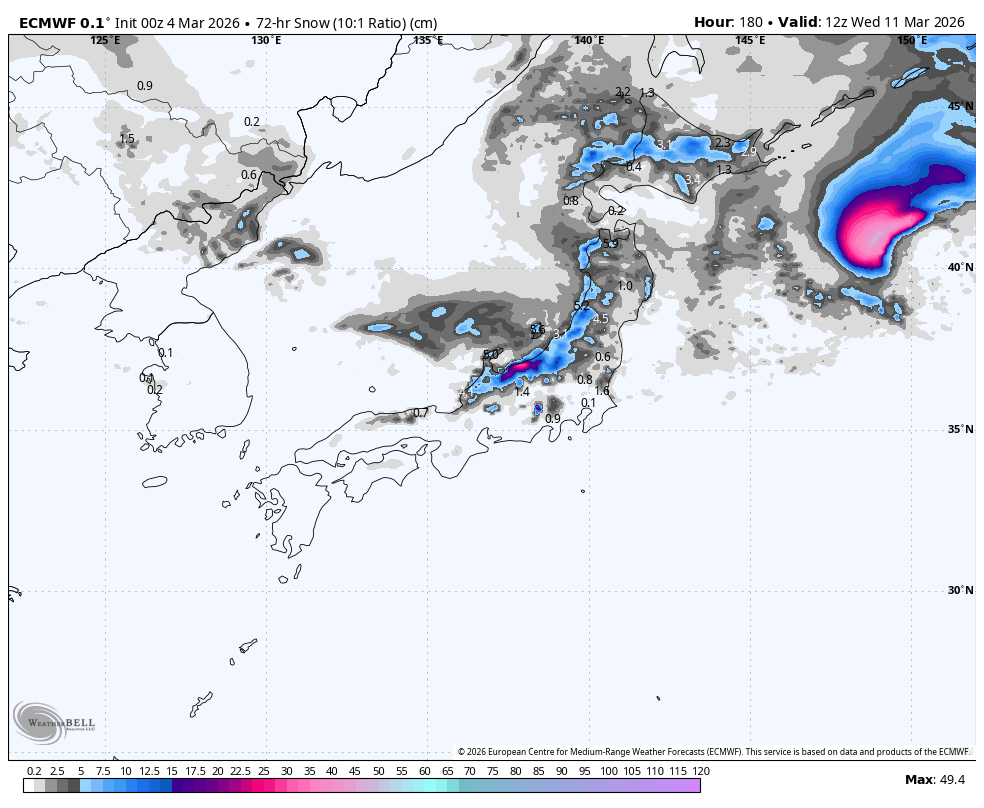
It was a rather warm and slushy weekend and start to the week for central Honshu, and the much-anticipated snowstorm that arrived on Tuesday didn’t materialise in Hakuba. However, it will have by the time you read this, with the storm hitting that area as I write. Still, other resorts elsewhere in central Honshu reported decent numbers this Wednesday morning.

It’s been a different story up north, where it’s been cold with steady snowfall.  Resorts in the north of Honshu and on Hokkaido have recorded 10-40cm of consecutive snowfall over the last five days.

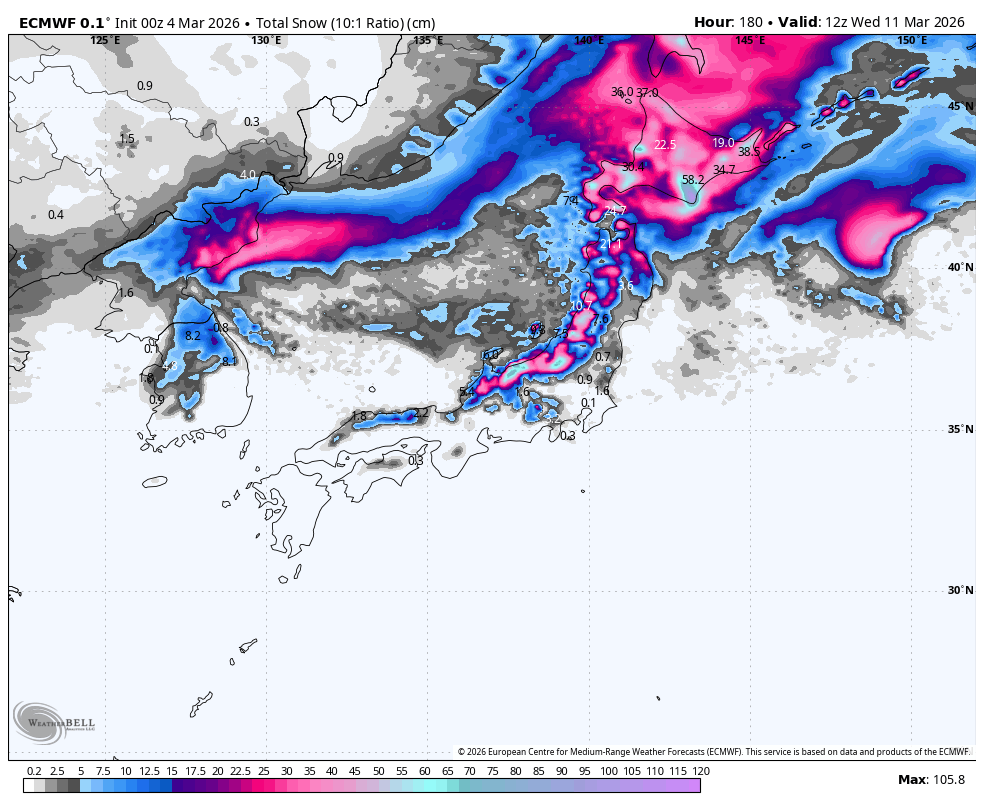
The storm cycle that kicked off on Tuesday will continue to rage over the country for much of the foreseeable future. It could be the biggest cycle of the season so far, and seven-day totals will be massive, especially in Central Honshu (Hakuba included), where snowfall will be heaviest this weekend and again from late Tuesday. Resorts further north will continue to pile on the powder too, with lighter, steadier snowfall.

For up to date on the ground conditions as this storm progresses, check out the daily snow reports for Niseko, Hakuba, Nozawa Onsen and Myoko.

7-Day snowfall accumulation. Note that snow depths here are calculated using a 10:1 ratio, where 1mm of rain equals 1cm of snow. This can significantly underestimate things here in Japan, where 1mm of rain often equates to 1.5-2 cm of snow owing to its light n’ fluffy nature. Source: ECMWF, WeatherBell.com

Thursday 22nd and Friday 23rd January

At the time of writing, much of the Sea of Japan side of Japan has snow showers on the radar, except for the popular Nagano prefecture. Niigata, on the other hand, is under a band of moderate-to-heavy snowfall moving in thick and fast. This band of snow marks a slight shift in winds to the northwest and a touch colder airmass.

The band of snow will push down into Nagano this Wednesday evening with a solid top-up of powder overnight, setting up an excellent day on the slopes for Thursday. Nagano will then see limited lighter snowfall on Thursday as the band retreats back up into Niigata, but it‘ll build a little through the latter half of Friday.

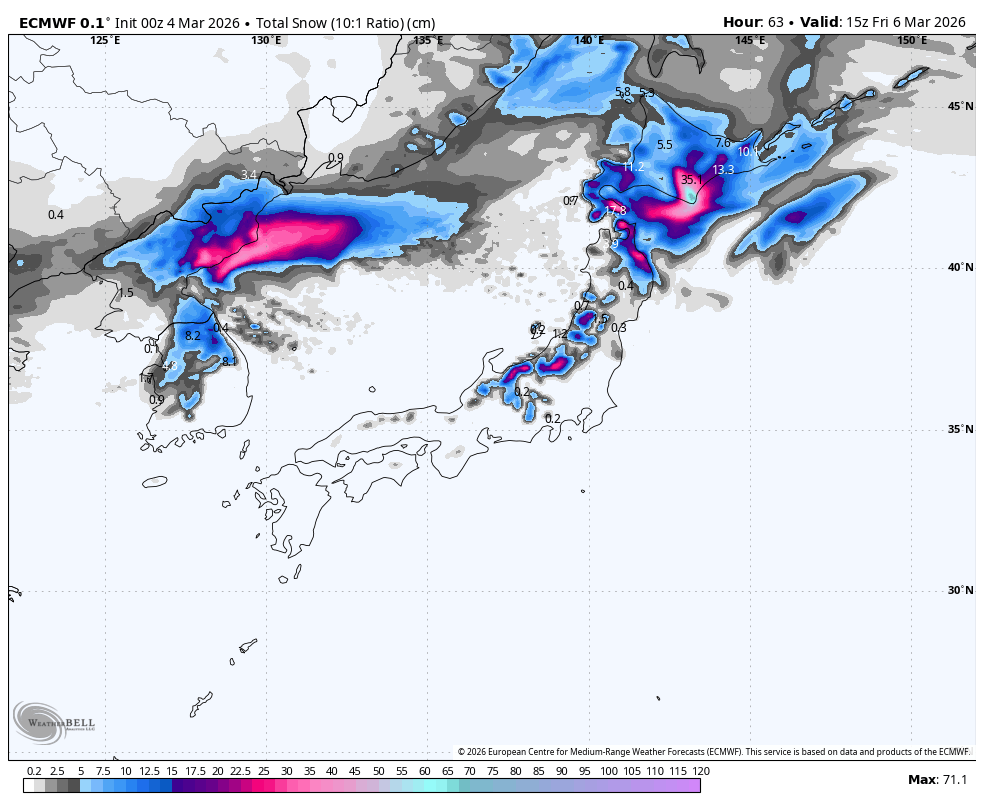
Fairly regular light-to-moderate snowfalls further north, along with isolated heavier falls, will see most resorts picking up a solid 20-50+ cm over this two-day period. Little can be said about the trend in snowfall, other than it becoming more widespread for a time on Thursday as winds tilt westward. 

Snowfall accumulation for Thursday and Friday. Source: ECMWF, WeatherBELL.com

Saturday 24th & Sunday 25th January

The storm cycle continues through the weekend, with heavy snowfall favouring central Honshu, where a whopping 50-100+ cm will pile up over a 48hr period. 

Northern Honshu and Hokkaido will generally see lighter and less persistent snowfall, but we should still see around 10-40cm across most resorts. Those furthest from the Sea of Japan coastline, such as Furano, will be on the lower end of that range.

Snowfall accumulation for Saturday & Sunday. Source: ECMWF, WeatherBELL.com

Monday 26th to Wednesday 27th January

Snowfall over central Honshu eases and possibly clears during Monday before the next storm surge hits later on Tuesday, with heavy snowfall once again returning and persisting through Wednesday (and possibly the following few days).

Snowfall rates will taper downwards over northern Honshu and Hokkaido, but they’ll be more persistent throughout this three-day period. So we should see a more even spread of snow throughout Honshu at least, with Hokkaido likely picking up a much lighter load.

Snowfall accumulation for Monday to Wednesday. Source: ECMWF, WeatherBELL.com

That’s all from me today, folks. Have a great week, and I’ll see you here next Thursday for another weekly rundown of Japan’s highlights and snowlights.

Grasshopper

Weekly North America Forecast – Settled Spell Continues, But Colorado & New Mexico Score Friday & Saturday 

Written Wednesday evening, 21st January (Pacific Standard Time)

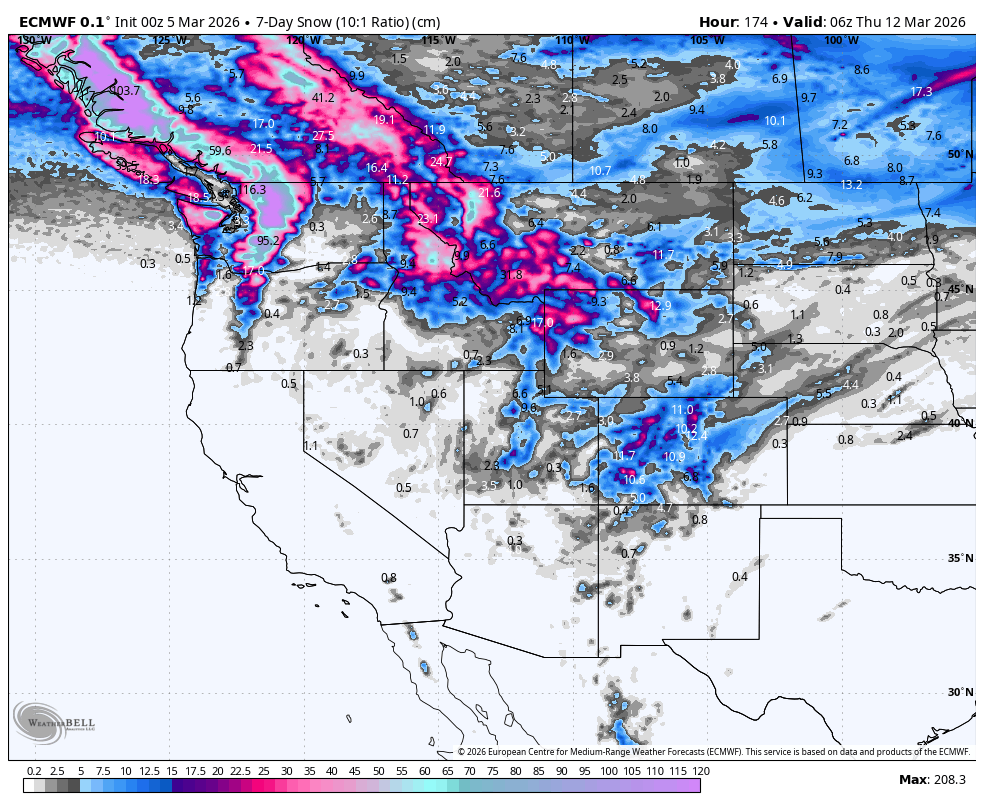
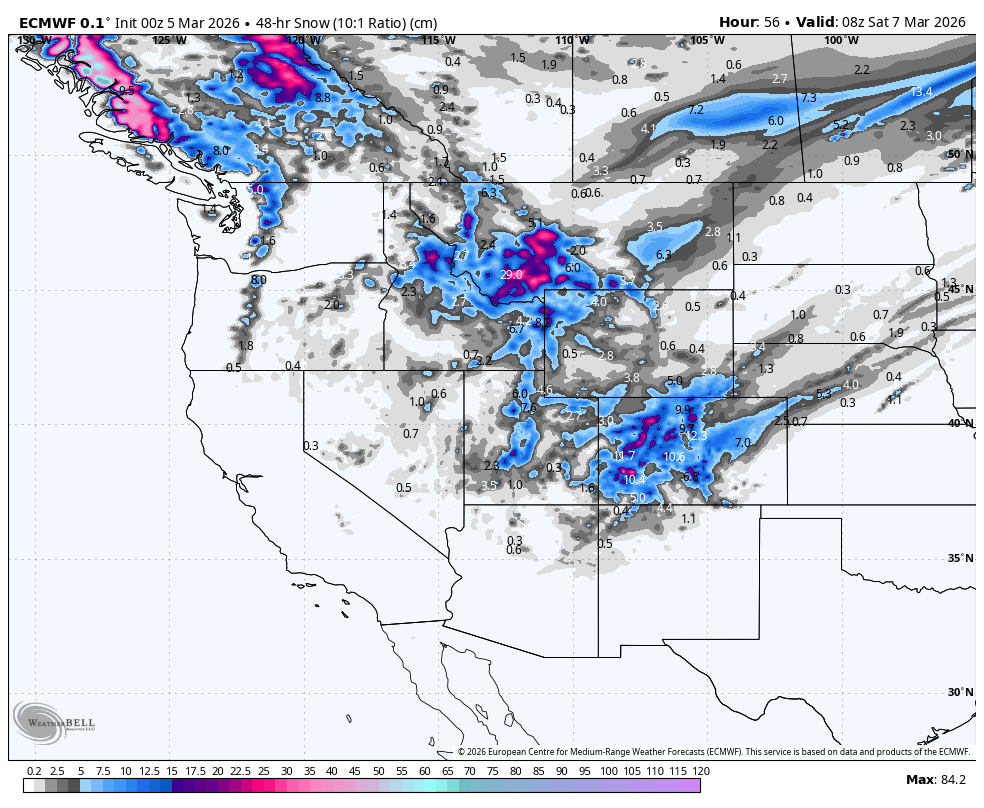
It’s been a quiet week in western North America. However, Colorado received up to 20-25cm after a freezing Arctic airmass brought light snowfall to the eastern Rockies. Colorado, along with New Mexico, will once again be favoured this week, thanks to a storm flaring up as it tracks eastward across the south during Friday and Saturday. Most resorts here will receive a desperately-needed 20-40cm, with 50+ cm possible in some spots.

Other than that, it’ll be a relatively quiet week ahead. The Rockies of Alberta and northern US will also pick up a couple of light dustings of high-quality powder as fresh waves of Arctic air push south. The cold temps will keep the bumper crop already established across interior BC and Alberta in good nick, and winter sunshine will make up for the lack of fresh snow.

Models are picking a storm will finally arrive somewhere along the Pacific Coast Crest at the end of this forecast period in what could be the start of a gradual buildup in the storm cycle.

7-Day snowfall accumulation. Note that snow depths here are calculated using a 10:1 ratio, where 1mm of rain equals 1cm of snow. This can significantly underestimate things here in North America, where 1 mm of rain often equates to 1.5-2 cm of snow, especially in the Rockies, where it can be really light n’ fluffy. Source: ECMWF, WeatherBELL.com

Thursday 22nd to Sunday 25th January

The situation remains quiet and settled across western North America on Thursday.  A very weak low-pressure system drifts eastwards over the Sierras, bringing snow showers to high elevations, favouring Mammoth with a few centimetres at best.

The weak storm will strengthen significantly on Friday and Saturday as it tracks further inland over the south. Light snowfall turning up in southern Utah and Colorado on Thursday night will become heavier and more widespread across the Southern Rockies as warm, humid air from the south meets a frigid Arctic airmass descending from the north.

By daybreak on Sunday, the system will have exited to the east, leaving a solid, much-needed 20-40cm of fresh powder over New Mexico and Colorado, with 50+ cm possible in some exposed areas. Arizona and Utah south of the Wasatch Range will also pick up 10-25cm. Resorts in Alberta, Montana and Wyoming will also pick up a dusting of powder in the 2-10cm range during this period via the Arctic airmass, which pushes down into the eastern side of the Rockies. 

Snowfall accumulation for Thursday to Sunday. Source: ECMWF, WeatherBELL.com

Monday 26th to Wednesday 28th January

With the southern storm away to the east, settled conditions once again return to western North America. Monday will be particularly quiet as high pressure dominates, and freezing temperatures continue to affect the northern Rockies, especially Alberta and interior BC.

Models get a bit wobbly and uncertain from Tuesday onward as they struggle to handle weak synoptic features. However, there’s a good chance another Arctic airmass sinking southwards will bring high-quality powder to the central-northern Rockies during Tuesday and Wednesday. Parts of Idaho, Montana, Wyoming and northern Colorado are likely to be favoured with anywhere between a light dusting and 25cm on the cards. Interior BC and Alberta also stand a chance at picking up some of this, but it’s most likely to be at the low end of that scale.

Later on Wednesday, a storm from the Pacific is expected to make landfall somewhere along the Pacific Crest. The storm will likely start warm with elevated snow levels at first, and if it starts in the Sierras, as the ECMWF model expects, then it should spread northward into the Cascades and Canadian Coast Mountains the following day, marking the first action the area has seen for over a week. 

Snowfall accumulation for Monday to Thursday. Source: ECMWF, WeatherBELL.com

That’s all from me today, folks. Have a great week, and I’ll see you back here next Thursday for another weekly rundown of North America’s highlights and snowlights.

Grasshopper

Latest Outlooks

1 55 56 57 58 59 63